Steel or Aluminum? Here's the Straight Talk Before You Drop Money on Your Next Big Purchase
Walk into any tool supply shop and you'll hear the aluminum pitch a dozen times. Lighter. Easier to carry. Modern. And sure, there's real truth in some of that. But there's also a lot of marketing noise that obscures a pretty important reality: for a significant chunk of trade applications, aluminum is a compromise — and sometimes a costly one.
This isn't a hit piece on aluminum. It's a practical look at where each material genuinely earns its place, so you're making the call with clear eyes instead of reacting to whichever salesperson you talked to last.
Let's Start With What Each Metal Actually Is
Steel is an alloy of iron and carbon, and its properties vary widely depending on the grade. Low-carbon mild steel is relatively soft and easy to work. High-carbon and alloy steels are harder, stronger, and used in cutting tools, structural components, and load-bearing hardware. The key characteristic of steel is density — it's roughly 2.5 times heavier than aluminum — but that density comes with proportionally higher tensile strength and impact resistance.
Aluminum is lightweight, naturally corrosion-resistant (it forms its own oxide layer), and easier to machine. It's significantly less dense than steel, which is why it dominates in aerospace, automotive, and applications where weight is the primary constraint.
Now here's where most comparisons go sideways: people treat weight as a universal benefit without asking what the weight is actually doing.
Where Aluminum Genuinely Wins
Let's be fair. There are real scenarios where aluminum is the better material choice.
Portable equipment that gets moved constantly. Aluminum ladders, scaffolding, and portable work platforms make sense when you're hauling gear up and down stairs or in and out of vans dozens of times a day. The weight savings are real and the cumulative physical toll on workers is real too.
Corrosion-sensitive environments without heavy loads. Aluminum's natural oxide layer makes it a solid choice in wet or coastal environments where you'd otherwise need to invest in rust prevention for steel. For light-duty brackets, enclosures, and housings in marine or food-service settings, aluminum holds up without much maintenance.
Non-sparking applications. In environments where sparks are a hazard — oil refineries, grain elevators, certain chemical plants — aluminum tools are often required by code. This isn't a preference; it's a safety mandate.
Where Steel Wins — And It's a Longer List
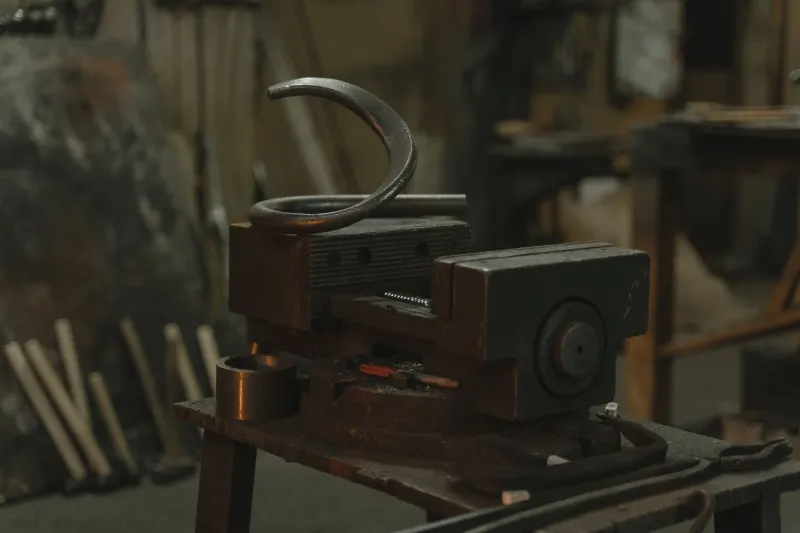
Impact and shock loads. This is the big one. When a tool or component needs to absorb repeated impact — hammer heads, impact sockets, structural fasteners, vise bodies, pipe wrenches — steel's higher toughness and ductility mean it deforms before it fractures. Aluminum under the same conditions is more likely to crack without warning. That's not just a durability issue; it's a safety issue.
Precision and stability. Steel has a lower coefficient of thermal expansion than aluminum, which means it holds its dimensions better across temperature swings. For precision tools, machine components, and anything where dimensional accuracy matters, steel is the more reliable choice.
Long-term wear resistance. Steel outperforms aluminum in wear resistance under friction and abrasion. Vise jaws, anvil faces, and cutting tool bodies stay functional longer in steel because the material simply holds up to surface wear better.
Cost per unit of strength. Here's the math that surprises people: when you compare cost per unit of tensile strength, steel often comes out ahead of aluminum. Aluminum's lower density means you need more material by volume to achieve equivalent strength in many load-bearing applications, which narrows the cost gap significantly.
The Misconceptions Worth Calling Out
"Aluminum is strong enough." For what? This phrase only means something in context. Aluminum can absolutely be engineered to handle specific loads — aerospace manufacturers do it all the time. But off-the-shelf aluminum trade tools are not aerospace-engineered. They're cost-optimized, which means they're frequently made to minimum acceptable specs. "Strong enough" often means "fine until it isn't."
"Steel is too heavy to be practical." For some applications, yes. For many others, the weight is inconsequential or even beneficial. A heavier vise doesn't move around on your bench. A steel-bodied floor jack doesn't flex under load the way a lighter aluminum-bodied one might. Weight isn't inherently a problem — it depends entirely on how the tool is being used.
"Aluminum doesn't rust, so it's lower maintenance." True in the sense that it doesn't develop iron oxide rust. False in the sense that it's maintenance-free. Aluminum oxidizes, develops galvanic corrosion when in contact with dissimilar metals, and can pit badly in high-salt environments. It just fails differently, not necessarily less.
A Practical Decision Framework
Before your next major purchase, ask yourself these questions:
- Will this item be moved constantly or stay in one place? If it's stationary or semi-stationary, weight savings matter less.
- Will it absorb impact or shock loads? If yes, lean steel.
- What's the consequence of failure? If a failure creates a safety risk or significant downtime, default to the more conservative material choice — which is usually steel.
- What's the actual total cost of ownership? A lighter aluminum tool that needs replacement in two years versus a heavier steel tool that runs for a decade is a math problem, not a preference.
- What does your environment demand? Coastal, wet, chemical-heavy environments favor corrosion-resistant materials. Dry shop environments favor durability over corrosion resistance.
The Bottom Line
Aluminum has earned its place in the toolkit — literally. But it's earned a specific place, not a general one. The trade industry's drift toward lighter materials has been partly driven by genuine ergonomic and logistical benefits, and partly by cost pressures that favor cheaper-to-produce aluminum components over heavier, more expensive steel alternatives.
Knowing the difference between those two drivers is what separates a smart buyer from someone who ends up replacing the same piece of equipment every other year and wondering why their tool budget never shrinks.