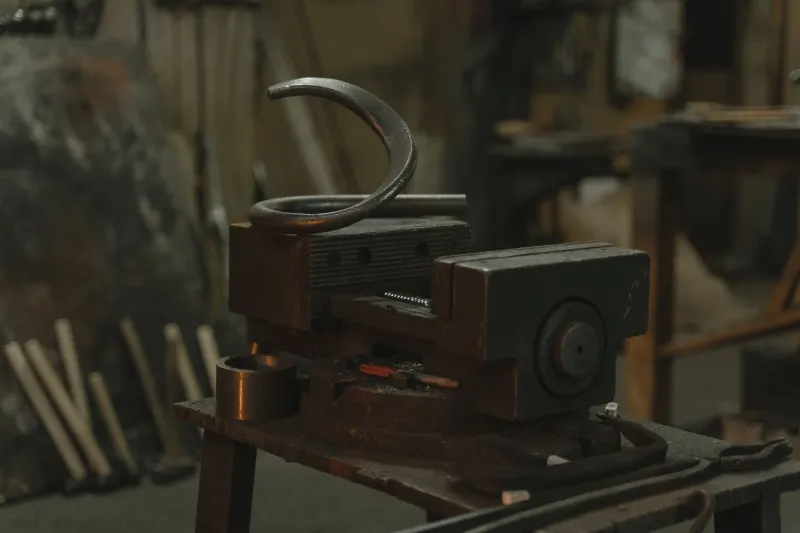
Why Some Shop Tools Last 80 Years and Others Fall Apart in 5: Cast Iron vs. Fabricated Steel Explained

Photo by Photo by Tahamie Farooqui on Unsplash on Unsplash
There's a certain kind of satisfaction that comes from picking up a vise or setting your hands on an anvil that was manufactured before your grandfather was born and finding it still perfectly serviceable. That durability isn't an accident, and it's not nostalgia either. It's metallurgy and manufacturing process doing exactly what they're supposed to do.
The conversation around cast iron versus fabricated (or welded) steel comes up constantly in trade circles, usually triggered by someone who bought a cheap import tool that cracked, warped, or failed under load. The comparison isn't always straightforward because both materials have legitimate strengths—and both have real weaknesses that don't show up on a spec sheet.
How Each Material Is Made
Cast iron is produced by melting iron with a carbon content typically between 2% and 4%, then pouring the molten material into a mold. Once cooled, you get a near-net-shape component—meaning very little machining is required to get the final form. The casting process allows for complex geometries that would be expensive or impossible to fabricate from plate and bar stock.
Fabricated or welded steel construction works differently. You start with rolled steel—plate, bar, tube, or structural shapes—and cut, bend, and weld those components into the final assembly. The base material is typically low- to medium-carbon steel with a carbon content well below 1%, which makes it significantly more ductile and weldable than cast iron.
Those two manufacturing approaches produce fundamentally different material properties, and understanding the difference explains a lot about why certain tools behave the way they do.
The Durability Profile: Where Cast Iron Wins
Cast iron's high carbon content gives it exceptional hardness and compressive strength. Under a static load—the weight of a workpiece in a vise jaw, the repeated hammer blows on an anvil face, the vibration of a machine base—cast iron is extraordinarily stable. It doesn't flex, doesn't creep, and doesn't deform over time the way mild steel can under sustained stress.
That rigidity is also why old cast iron machinery bases and surface plates are still in service decades after fabrication. Dimensional stability matters enormously in precision applications, and cast iron delivers it reliably.
Another often-overlooked advantage: cast iron has excellent vibration-damping characteristics. That's why traditional woodworking machinery—table saws, jointers, planers—has historically used cast iron tables. The material absorbs harmonic vibration rather than transmitting it, which improves cut quality and reduces operator fatigue.
Where Fabricated Steel Has the Edge
Cast iron's rigidity is also its Achilles heel. The same high carbon content that makes it hard makes it brittle. Drop a cast iron vise jaw or anvil horn from a significant height onto a concrete floor and you may end up with a cracked or shattered component. Impact loading is cast iron's worst enemy.
Fabricated steel, by contrast, is ductile. It bends before it breaks. In applications where shock loading, impact, or dynamic stress is part of the job, welded steel construction often holds up better simply because it can absorb and redistribute energy rather than fracturing.
Fabricated assemblies are also easier to repair. A cracked weld can be ground out and re-welded. A cracked casting is a much more involved fix—specialty cast iron welding or brazing techniques exist, but they require skill and the right filler materials, and results are variable. Many shops simply replace cracked cast iron components rather than attempting repair.
The Total Cost of Ownership Calculation
This is where the conversation gets interesting, because upfront price and long-term cost are very different numbers.
A quality cast iron vise from a reputable American or European manufacturer might run two to three times the price of a fabricated steel import. But if that cast iron vise serves a working shop for 30 or 40 years with minimal maintenance—just periodic cleaning and lubrication of the screw mechanism—the cost per year of service is often lower than a cheaper fabricated tool that needs replacement every five to eight years.
The math changes, though, if the tool is subject to conditions that favor fabricated steel. A vise used primarily for heavy forging work, where thermal cycling and impact are constant, might actually benefit from a steel construction that handles those stresses without risk of catastrophic cracking.
How to Spot the Difference (and Why Counterfeits Complicate Things)
The import market has introduced a category of tools that are neither genuinely cast iron nor quality fabricated steel—they're often made from inferior gray iron with inconsistent carbon distribution, or from low-grade steel with minimal quality control on the welds. These tools look the part but fail in ways that genuine cast iron or properly fabricated steel wouldn't.
Some things to look for when evaluating a tool:
- Weight: Genuine cast iron is dense. A vise or anvil that feels light for its size is a red flag.
- Surface finish: Quality cast components have a consistent, fine-grained surface texture after machining. Pitting, voids, or rough casting marks on machined surfaces suggest poor quality control.
- Weld quality on fabricated tools: Look for consistent bead profiles, proper penetration, and no visible porosity or undercut at weld toes.
- Rebound on anvils: A properly hardened anvil face will return significant energy from a ball bearing drop test. Soft or low-quality iron absorbs energy and returns very little.
Matching the Material to the Application
For precision work—surface plates, machine tool bases, vise bodies used for machining operations—cast iron remains the gold standard when sourced from a quality manufacturer. For dynamic, impact-heavy, or outdoor applications where corrosion protection matters (cast iron rusts aggressively), fabricated steel with appropriate coating or plating often makes more practical sense.
The best shops have both. They know which tool to reach for depending on the task, and they understand why the material choice matters as much as the design. That knowledge is what separates a well-equipped trade professional from someone who keeps replacing the same broken tool every few years.